Rocky Movie Chasing Parked Cars Again
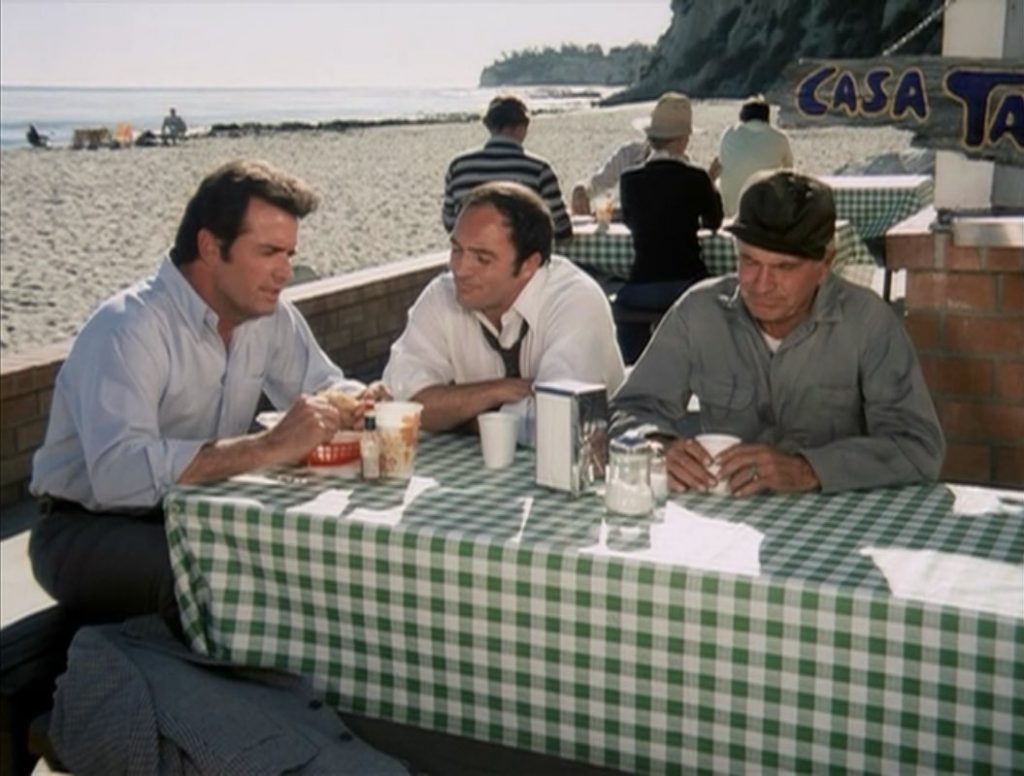
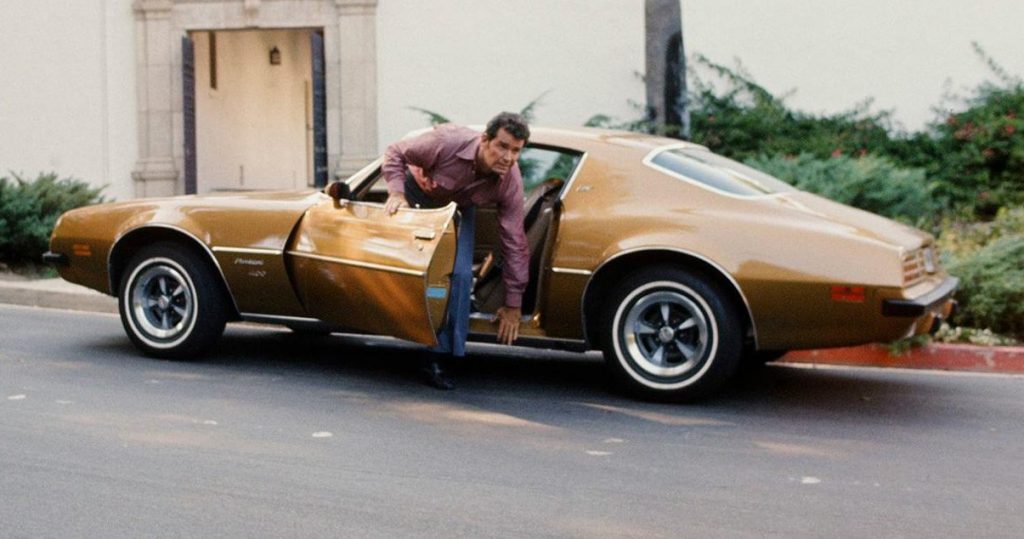
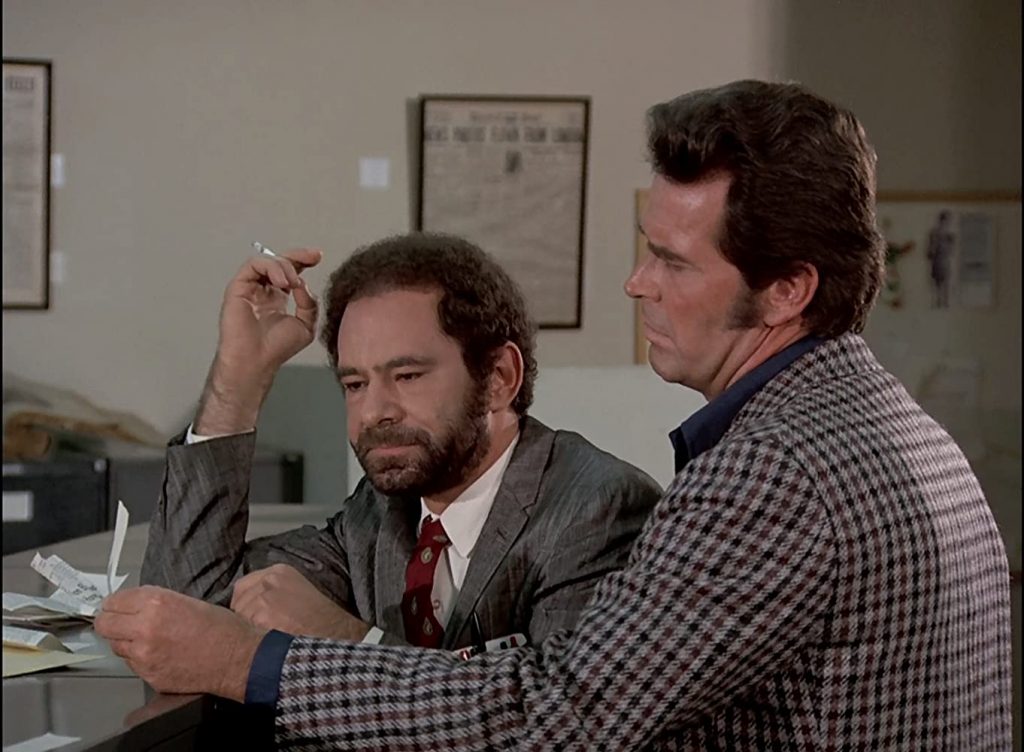
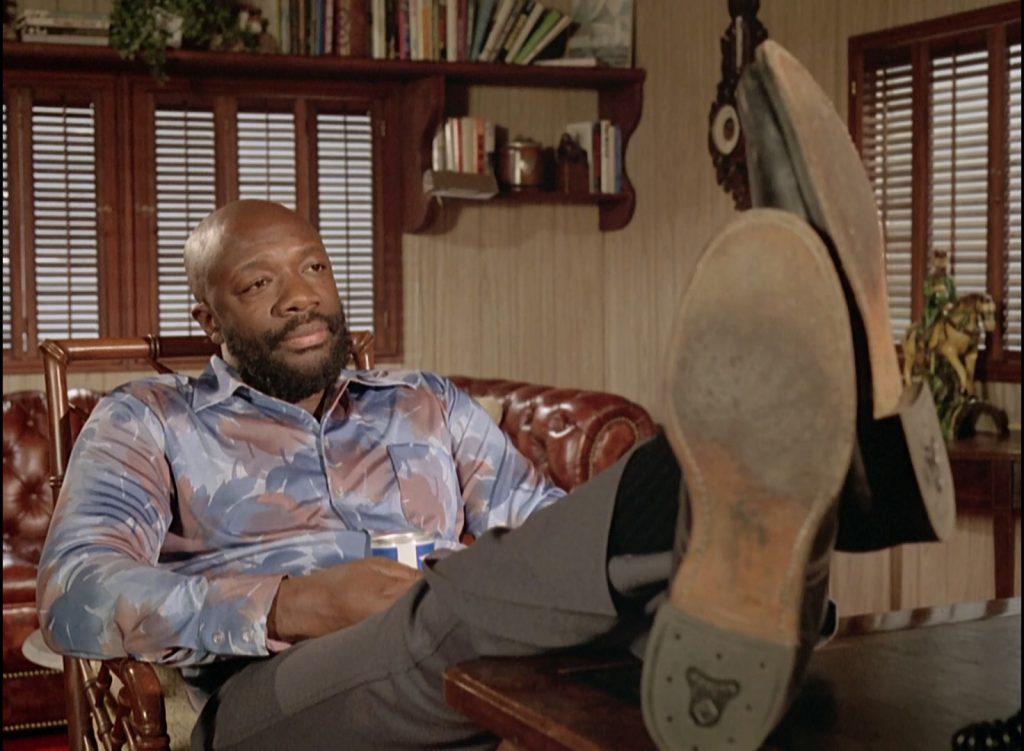
I don't remember why I watched the pilot episode that came on one night later on dinner in 1974: in those days before our family had a remote information technology was sometimes a passive determination, simply easier to keep watching in the blimp chair than cross the room and plough the dial. But great discoveries tin come from laziness, so after seeing an former vagrant ride a city bus to the end of the line and go strangled by a weightlifter nether Santa Monica Pier, the story moved to an Fifty.A. bikini shop, where a handsome sideburned human was reluctantly agreeing to investigate the death for the victim's daughter (Lindsay Wagner) as she dressed a mannequin. The first show did not reek of tough-guy promise. First of all, he turned down the chore he was hired for not once but twice, and except for his California P.I. license he seemed like merely another big affable guy with ordinary problems: an understocked fridge, people hectoring him through his answering machine. His concerns seemedunheroic and, mayhap worst of all, he did non even carry a gun, keeping one only for emergencies in a cookie jar in the kitchen of his house trailer. And when at one point his client asked, a little concerned, "Yous're not afraid of him, are you?" he told her the truth, "You're damn right I am." Simply what grabbed me from the first episode was one hilarious scene: Jim Rockford, tired of being trailed by the vagrant's muscular killer (William Smith) in a long ruby convertible, pulls into the Mayfair Music Hall, a Santa Monica venue of vaudeville-era entertainments. The bow-tied bartender greets Rockford and asks "The usual?" as a young woman performs a slow split atop a wire, meaning Jim either comes here often to lose a tail or he likes novelty acts. After his brawny pursuer enters the bar and growls his drink social club, Jim heads to the men's room to prepare his trap. The Mayfair switches to a troupe of dancing poodles as Rockford'south man stalks to the bathroom, where Jim has drizzled hand soap across the floor and retrieved a ringlet of nickels from his coat pocket, taunting, "You musclebound guys are ever overcompensating." The charge of latency draws a macho scream and a high kick that slides him back onto the soapy tile, where Jim lands a inexpensive insurance shot. According to Ed Robertson's history of The Rockford Files, this scene nearly broke the ASI meter when the pilot was tested, and may have made the show. Information technology did for me. By cheating a little, it seemed a clever human could take down a dandy. I was hooked. To an 11-year-old, Jim Rockford had a life I could happily imagine for my future self: He lived alone in a beaten green and white trailer on a promontory over a Malibu beach, where he spent much of his free fourth dimension surfcasting, often with his dad, a semi-retired longhaul trucker known as Rocky, whose whole beingness seemed to revolve effectually fishing with his adult son; when he worked, Jim Rockford charged clients an impressive-sounding "$200 a twenty-four hours plus expenses" for snooping effectually and he collection a absurd gilt Pontiac Firebird Camaraderie in which he outmaneuvered Mob wheelmen and hot-headed Feds. (The car hunt thrived on 1970s TV the way the ballsy guitar solo dominated '70s rock.) Article continues afterward advertisement Over five and a half seasons, Jim Rockford would offer a number of life lessons: That you lot tin can gain entry to many social functions just by wearing a blue sport coat or phony glasses; when impersonating salesmen, it's good to accept a variety of drawling accents and bold hats; any business organisation office can be accessed either with a gear up of quality lock picks or by double-talking the receptionist and showing fake business cards y'all can print in your car; in a high-speed hunt, you can often outsmart goons with a absurd reverse J-plough move they somehow never wait; sometimes y'all'll work for people y'all detest, and so know how much you're willing to take; likewise, being a good listener is not only nice manners but also can be professionally useful. And finally, if you want the dream of a home function without paying a secretary, then hire an answering machine (rather new at the time). The Rockford Files' opening sequence did not prove the usual action shot, chalk corpse silhouette, or hero swirled in police lights but a pan of Jim's untidy desk laid with playing cards and a large continuing photo of his dad, as the answering machine plays. Jim's letters famously began every episode, ensuring that fans of the show would be in their seats as it opened: "Hey Jim, this is Louie down at the fish market—you gonna pick up these halibut or what?" Jim's way may be sardonic, but he can be decent to a mistake, rare among earth-weary sleuths, perhaps because his father Rocky believes the best of people. Rocky was appealingly played by Noah Beery, with his can-do 1940s cowboy demeanor. (If you take seen Red River he is office of the montage of cowhand faces howling to launch the famous cattle drive). Rocky is always telling his son to bulldoze a rig (it'south safer) or come to the motel to hunt and relax from the hazards of the investigator'south life. Writer Stephen Cannell created Rocky thinking of his own male parent, who was puzzled by his strange choice of profession instead of joining the family unit business. There is scant evidence in the show that Jim ever had a female parent; perhaps it would be too painful to talk most. Rocky hopes Jim will get married and discover a less unsafe line of work, merely e'er helps him out when goons come to the trailer, which is ofttimes. (Rockford's trailer may be the most-tossed location in TV history.) After ane close call, however, Rocky finally blows up : "I am through talking to you! Look at you, an inch or two to the right and y'all'd exist missing that eye!" Commodity continues after advert "Yeah," answers Jim, "but look at it this way, an inch or ii to the left and he'd have missed me completely." Rocky is not amused. It is hard now to appreciate the freshness of Jim Rockford's adventures against its era of old school police dramas and newer crime shows with smirky tag lines. The Rockford Files seemed revolutionary in existence and so funny and however delivering a tense criminal offense plot. It is difficult now to appreciate the freshness of Jim Rockford'southward adventures against its era of sometime school police dramas and newer crime shows with smirky tag lines (Kojak's "Who loves Ya, infant?' or Baretta'southward "And dat'southward the name of dat melody"): One of the funnier Rockford episodes, "A Clean Bust with Sequel Rights," spoofs such shows, when Jim is hired by an insurance company to "babysit" a celebrity cop (Hector Elizondo) whose police exploits have become a bestseller, motion picture, Television receiver show and kids' toy line. It pains Jim how his father is thrilled watching the TV detective shout, "Freeze, Turkey!" as he makes the bust. (In fact, Rockford Files began as an unused plot idea for another projection of producer Roy Huggins, the short-lived Detective series Toma, which itself then morphed into Robert Blake's Baretta.) Jim had none of the hard-drinking tough guy detective who needs to be saved from himself and he would not be caught walking around with Baretta'due south cockatoo on his shoulder, either. In the 2d flavour ("The Big Ripoff," Ep7) we get as close as we come to a Rockford code: Jill Clayburgh plays a immature artist's model who rescues Jim later on he's been badly beaten up. As he returns to his dangerous work, she asks, "Is in that location whatever thing you won't do for money?" "I won't kill for it," Rockford answers, "and I won't ally for it. Other than that, I'm open to just about annihilation." At the time The Rockford Files appeared, the closest thing to it was Harry O, whose private eye worked on his boat when not solving crimes. Merely Harry retained the gravitas of the police detective he once had been; Rockford'south sense of justice comes from his serving five years for a robbery he didn't commit, before receiving a pardon and learning to become a PI. Still, I'm sure the ex-cop and ex-con could have gone fishing together in Harry's gunkhole. Article continues after advertizing Now, when many TV investigators have a drug habit, a debilitating phobia or a splattery by as a serial killer, it is hard to have seriously the "anti-hero" packaging that accompanied these Rockford episodes. But he was, in the same way as James Garner'southward before character Bret Maverick stood apart from the stolid lawmen and bold gunfighters of the Westerns that crowded the belatedly 1950s Goggle box schedule. Maverick, its creator maintained, was a show in which the situation was ofttimes hopeless only never serious. The Rockford innovation was really a renewal of Bret Bohemian's sly pose in a new setting. Garner, an Oklahoman of part-Cherokee heritage (his production company was Cherokee Productions), had joined the Merchant Marine as a teenager in World War II and after received 2 Purple Hearts for his service in Korea, all the same fabricated a disarming leading man reluctant to go to war, most famously with Julie Andrews in The Americanization of Emily. The self-interested hero was charmingly done on Maverick, where Bret toured Western towns and river boat cities in search of poker and cursory romance and usually institute danger besides. Maverick was a difference from the glut of Television receiver Westerns; he was neither noble nor icy veined, and not disposed to gunplay withal capable if trapped by frontier circumstances. His storylines did not teach a hokey lesson about Americanism; he was mostly concerned for himself, trying to survive on his menu skill and wits. When a similar craze for private heart shows overtook the networks almost twenty years later on Maverick, James Rockford appeared, with a like take on life, though considerably less cardplay, as a perfect character for Garner. Like Maverick, Jim Rockford seeks no trouble, freely admits fright and turns downwards work as besides unsafe, but if cornered, he tin handle himself. (Others take noted that he unstoically shakes out his hand afterwards using his fist.) Executive Producer Roy Huggins, who had originally created Bohemian as well as The Fugitive, now retooled a number of storylines for an updated setting, while writer Stephen Cannell, who had been a corking fan of Maverick, had Huggins's permission to infringe its plots and spirit for Jim Rockford. * * * Article continues after advertisement Rockford's existence an ex-con allowed the writers a secondary cast of colorful guest spots and returning characters emerging from San Quentin, from Isaac Hayes to Eddie Fontaine to Stuart Margolin. (More on Isaac Hayes—and the spinoff series that should have happened—beneath.) Rockford never entirely dismisses his criminal acquaintances, fifty-fifty those who beat him upwardly when they served together. He is as well (like Garner himself) a Korean vet, which allows Ned Beatty or Ken Swofford to reenter his life citing war buddy favors owed. Even Jim'southward one-fourth dimension parole officer is on the make. Of all the characters, though, from Rob Reiner guesting as a sleazy minor quarterback to Claudette Nevins equally an anti-feminist author, it is Rockford'south one-time cellmate, 'Angel' Martin who is the most entertaining, appearing in almost a third of the episodes. The Rockford Files is at its funniest whenever the nervous Angel shows upwards to complicate Jim's life. ("Jim Buddy-buddy," one Rockford phone message begins, "You know how they allow you one phone call? Well, this is it. Hello? Hullo?"). Angel is your needy grifter friend who always disappoints. (Find out why Angel deserved his own spinoff below.) The Rockford Files mostly predates the era of flavour arcs, except for occasional two-part stories, so there are various methods for choosing where to beginning watching, if y'all missed information technology originally. You tin can binge direct through its 118 episodes, or begin with those in which 'Affections' appears; or watch every ane written past co-producer David Chase (afterward of The Sopranos), who fifty-fifty then steered plots back toward the Jersey mob; or see any episode in which Rockford is comically paired with a rival P.I. such as Tom Selleck (as the impeccable Lance White). Rockford'due south frustration with people and events is i of the evidence'southward many pleasures. His crucial friendship with Sgt. Dennis Becker brings Jim regularly into his to the lowest degree favorite setting, the constabulary station house, where he is tolerated at best, and sometimes briefly arrested. For a 1970s detective, Jim Rockford has impressively few cringey moments with the show'southward female person guests, a serial of bright and believable women often created past author-producer Juanita Bartlett. With women, Rockford is a courtly skilful listener who happens to live in a trailer. We are told that he used to date his lawyer, Beth (Gretchen Corbett) and the writers occasionally break Jim's heart with a disappearing fiancée or a blind psychologist girlfriend who dumps him. (Rita Moreno won an Emmy portraying a prostitute and police informant whom Jim helps.) One-time flames (Susan Strasberg or Valerie Pointer) render mainly when they want him to fix something in their lives or to set him upwardly as the fall guy delivering a briefcase. He loyally complies, and oftentimes regrets information technology. Commodity continues after advertisement Many shows have been influenced past The Rockford Files or take sought to strike its balance of elements—simply yous demand the writing and you lot need James Garner, and nobody has had both. Recently, Republic of Doyle, a CBC prove near a father-and-son detective bureau in Newfoundland, claimed to be inspired past information technology, but at that place isn't a strong resemblance. There may be something Rockfordesque in some of the manly banter on True Detective, just its overall mission is much darker. Many shows have been influenced past The Rockford Files or have sought to strike its balance of elements—but you need the writing and you need James Garner. Guy Pearce's superb serial for Australian Tv, Jack Irish, (based on the Peter Temple novels) comes closest to the marking. It has some of the wit and offbeat spirit, especially the splendid character writing, with a grumbling array of old bar types and marvelous racing touts. Jack is a compelling stubbled presence with rich side hobbies, and something nearly a scene when he gets vanquish up and so peed on past gunless Aussie thugs seemed particularly evocative of The Rockford Files. But Jack does have his morose drinking bouts, another investigator with demons. (His troubled late father, it seems, was no Rocky.) Jim Rockford may feel bad or overly responsible well-nigh events in his life, but he seldom feels openly deplorable for himself; Rocky wouldn't have it. Information technology's also easier to clear your head where he lives. Jim recovers from the tragedies in his piece of work with a walk down the embankment, or a fast drive along the coast in his Firebird, then he's dorsum dwelling to discover his tackle. Then he beats on, casting into the surf until the next stranger pulls up, pauses a skeptical beat earlier his trailer door, and knocks with a new case. I'm expensive, Jim will explicate inside, brushing off a space to sit. Article continues afterward advertising ___________________________________ ___________________________________ At that place are definite worsts, just far too many peachy episodes to select a simple best list. And so I have a sampler of some favorites too as a strongest season (Flavour 3). Also, since 1970s Fifty.A. is his scruffy co-star, I am less fond of episodes set out of boondocks (in Hawaii, Denver, Seattle, or Vegas), basically anytime Jim is deprived of his real automobile. Stings and Counter-stings: Some favorites tend to be plots in which Jim organizes ambitious revenge cons inspired by The Sting: In "There's One in Every Port," (Flavor 3, Ep 12) he pulls off the textbook Big Con confronting a begetter-girl team of maritime scammers. "Counter Gambit" (Flavour ane, Episode xvi) is a wonderful revenge scam in which Jim is beginning hired past ex-cons allegedly to find a missing girlfriend, just they are secretly just after her pearl necklace, which they intend to steal and blame on Rockford. The one priceless scene comes when Angel is forced to substitute as the terrified appraiser for the criminals' jewels. Multiple PIs: The show's writers loved detectives, but even more when they could concoct detective stories within detective stories, such as "Prissy Guys Stop Dead" (Season 6, Ep 7). It begins with a PI convention where Jim is up for an unlikely but well-deserved laurels, nominated past PI Lance White (Tom Selleck, before his Magnum days). Jim'southward moment is spoiled by a murder in the Men'due south room, forcing individual eyes who can't stand or trust each other to band together for the solution. White (Selleck) does everything handsomely wrong and even so succeeds, to Jim's increasing annoyance. Similarly, in "Sitcks and Stones May Break Your Bones, simply Waterbury will Bury Y'all" (Flavour 3, Ep 13), a Pinkerton-like large agency is killing off the region's little PIs (including guest star Cleavon Little) for their turf, and the remaining independents must ring together to uncover the plot. "The House on Willis Avenue" (Season 4, Ep 21), an epic two-parter, starts at the funeral of an old private eye who was Rockford's mentor learning the business organisation; at the service, Jim meets a much younger detective who shared this same teacher and finds the circumstances of his death curious: the pair uncover a strange criminal network of computers run by withal some other detective (Jackie Cooper). This story ends with a prescient onscreen alert virtually the national threat posed by "Clandestine information centers, building dossiers on individuals…" Article continues after advertisement Homefront: In "Paradise Cove" (Season 6, Ep one), Jim has to defend his home on two fronts: enduring the simultaneous claiming of a court-appointed receiver's inventory of his possessions to pay a lawsuit settlement against him, and a threat from a fellow member of his Paradise Cove Homeowners' Association, who secretly wants the golden bullion that may or may not be hidden beneath Rockford's trailer from a long-ago heist. Mariette Hartley, who was already selling Polaroid cameras in a serial of charming TV ads with Garner, guests every bit his courtroom-appointed creditor who becomes gradually interested in the intrigue off the books. (Hartley was asked then often nigh her apparent Tv set marriage to him that she had a T-shirt printed, I'chiliad non Mrs. James Garner.) This episode, which opened the final flavour, has a funny premise: Likable as he is, what homeowners' group would want Jim Rockford living among them, with his frequent violent visits from goons? It is worth it for Angel's Treasure of the Sierra Madre speech lonely, when he thinks the gold volition be theirs. ___________________________________ ___________________________________ In a later time of Better Call Saul or Adjourn Your Enthusiasm, in which character is destiny and comic, cocky-sabotaging flaws drive the drama, Evelyn 'Angel' Martin would have enjoyed his own spinoff series. Unsuccessful as both a squealer and small-fourth dimension con man, each calendar week Angel could overplay his hand in a different scheme that collapses. (Earlier taking the Angel function, Stuart Margolin had appeared with Garner on the brief-lived TV Western, Nichols.) You lot tin can construct your ain serial—call it City of 'Angel'—out of the 37 episodes graced by his manic presence. Angel's escalating lies are sort of the bespeak, and the failure of each con, like the edifice of a archetype comedy gag, is as funny as it is anticipated. (Garner himself subsequently confessed he had no thought why the 2 characters were still friends, but it amused the rest of us.) "Jimmy, I had to stay alive," Affections explains some latest betrayal. "You're alive," Rockford concedes. "You take plenty of expert years left for sniveling and complaining." In one episode, he forges papers to sell someone a horse that "could" be "Secretariat'south long-lost son" ("a grayness area," he concedes to Jim); in another, ("Rattlers Grade of '63") Angel asks Jim to exist his best man an hour before a wedding that turns out to stem from a botched grift. "Information technology's a variation on the Red Befouled con," he confesses after the ceremony turns into a ball with the helpmate'south family unit. "Then why," Rockford reasonably asks, "did you ally the marker's sister?" Article continues later advertisement In "Drought at Indian Head River," (Season three, Ep thirteen) Angel is suddenly rolling in coin as an unwitting front in a mob real manor scam controlled past Robert Loggia. When Jim visits Angel's new penthouse to warn him that he is about to be killed, Angel cuts him off: "I go by 'Angelo' now. 'Affections' is not an important proper name." In another story, Angel becomes a material witness needing law protection, insists the cops serve him his meals in his motel bed, and decides the time has come to dictate his memoirs. And in "Canis familiaris and Pony Show" (Season 4, Ep 5) Angel again gets Jim arrested along with him, and a judge decides they both need to attend group therapy. In the sessions, Angel spins a long tale nearly his mythical family and work for the CIA (" I'm just glad the Agency didn't find out well-nigh my gun running days because of all this. I tin can't say anything more." ) . It hit the news this past winter that some websites were advertising murders for hire but keeping the Bitcoin without following through on the killing part. I remembered Angel's similar (but flawed) scheme of advertising every bit a hit human and keeping the client's money afterward the face-to-face handoff. "Jimmy, you lot got to help me," Angel begs when his ain life is threatened. The problem with Angel is he doesn't stay helped. A show based on Affections and his imploding cons would find an piece of cake home today. When The Rockford Files staged a brief return in the early '90s it showed Angel failing as a looter in the L.A. riots (sadly choosing to cover his head with a clear plastic bag that left him recognizable to Police choppers). According to Ed Robertson, the gag was the idea of Stuart Margolin, who had won 2 Emmys playing Angel and knew him better than anyone. Article continues after advertising ___________________________________ ___________________________________ I loved the original Spenser for Hire, simply take e'er wanted to run across a crime show where the white guy is the strong-arm sidekick, the Hawk role. In 1977, the makers of The Rockford Files tried to get ane better: using a Rockford episode ("Just Some other Shine Wedding," Season iii, Ep 17) as a possible network spinoff about its 2 guests—black investigators played by Louis Gossett, Jr. and Isaac Hayes, at the height of his post-Shaft absurd. Each character had appeared previously on Rockford, 1 as Jim's one-time parole officer, Marcus Aurelius "Gabby" Hayes (Gossett) who has become a high-end PI who hones his refined image by driving around in a Rolls Royce on an extended exam drive; the other is Gandy Fitch (Isaac Hayes), a brusque-fused ex-con Jim knew to avoid at San Quentin. In a previous episode ("The Hammer of C Block," Flavor 3) Rockford helped Gandy clear himself of the crime for which he had served 20 years. When Gandy looks up "Rockfish" again in this spinoff episode, bankrupt, and insists on working as Jim'due south muscle, Rockford arranges a tiffin and tries to unload him on Marcus Hayes, his old parole officer turned slick investigator, who sticks Jim with the price of the meal, then tries to steal Rockford's electric current case, offering to cut Gandy in on the finder's fee. This episode has a lot to recommend information technology, simply is famous for a scene where the pair blunders into a meeting of Neo-Nazis in a Los Angeles bar; polka music plays as members shoot pool and swig beer in full uniform. The cues are swinging soon after the blackness strangers enter, and Hayes (Gossett) grabs the bartender'southward sawed-off shotgun and blows abroad the framed Hitler portrait. The pair make righteous work of the jackboots, then Hayes delivers a critique worthy of our time: "So, these are the rough, tough right wing National Socialists we keep hearing nigh." As police sirens wail louder exterior he lectures his bruised audience on the strength and virtue of the American heart course before Gandy can drag him away. "I remember that went well," he gloats, safely in the backseat. "Yeah," Gandy admits, "you lot were cookin'." A partnership is born. Article continues after advertisement At a time when blackness actors on crime dramas frequently played pimps, streetwalkers, drug dealers, or addict-informants, this try at a spinoff series with two black detectives was ambitious. That "Gabby & Gandy" was non picked up is disappointing but not to be blamed on its era alone. No network program similar it followed. Isaac Hayes would return (solo) to The Rockford Files as Gandy the post-obit season (in "2d Chance," Season 4, Ep 4), request Jim's assistance to protect the life of his current girlfriend, played by Dionne Warwick, whose songs Hayes covered and then soulfully. ___________________________________ ___________________________________ It turns out that at that place are still quite a number of us who, anticipating a situation where we might feel a little imposterish, attain for the dark sports jacket as Jim would practice. Here are some ways to celebrate, discuss, and fifty-fifty learn more nigh The Rockford Files. Watching: The Rockford Files is distributed by IMDB, for free with ads, on the IMDB site and too streams through Amazon Prime number. Its superb progenitor, Maverick is available for buy through Amazon, YouTube, and ITunes. Rockford Files is also available (with the 1990s TV movies) in a 22-DVD boxed set, The Rockford Files: The Complete Series (Mill Creek Entertainment). Books: 30 Years of The Rockford Files by Ed Robertson (ASJA Pr., 2005) or Robertson's earlier 'This is Jim Rockford': The Rockford Files (20th anniversary Tribute, Pomegranate Press, 1995). Robertson did many interviews with the show'due south principals, and presents a good history of the program'due south evolution as well as synopses of all the episodes. For more stories about the making of Maverick and Rockford see The Garner Files: A Memoir past Jon Winokur and James Garner (S&S, 2012), and an earlier fan's volume, The Rockford Phile: The Unofficial Casebook of the Rockford Files past David Martindale (Pioneer Books, 1991). Article continues afterwards advertisement Podcasts: Tribute books are nice, but if you lot actually want to disappear downward an entertaining rabbit pigsty filled with pieces of the world of 29 Cove Rd., this podcast can exist pretty fun. Run by two young gamers who found the prove decades after its network reign, in some ways their project resembles paleontologists studying the lost age when long, high-powered vehicles roamed the Earth in California car chases. Creators Nathan D. Paoletta and Epidiah Ravachol have appropriately named their forum Two Hundred a Twenty-four hour period: A Rockford Files Podcast, and on it they discuss every episode'southward plot and craft and the intellectual predilections of its writers, while offer their own accompanying detective-style notes, presented in spreadsheet grade: the make of every evocative PGC (Master Goon Car) is catalogued, from a goonish light-green and white 1973 Dodge Charger to a cherry-red and white 1975 Lincoln Continental, whether involved in an episode car chase or only a sinister visit to the trailer to grab Jim or toss his identify. Too, you'll observe running tallies of each of Jim'south love taco lunches, those of his expenses left unreiumbursed, and plot points like: "Dennis can't launder his ham-and-cheese sandwich down because the station coffee is bad." Archetype Brooklyn-curmudgeonly Dennis! Pick your favorite episode under discussion and see if you agree. (Apple tree Podcasts) 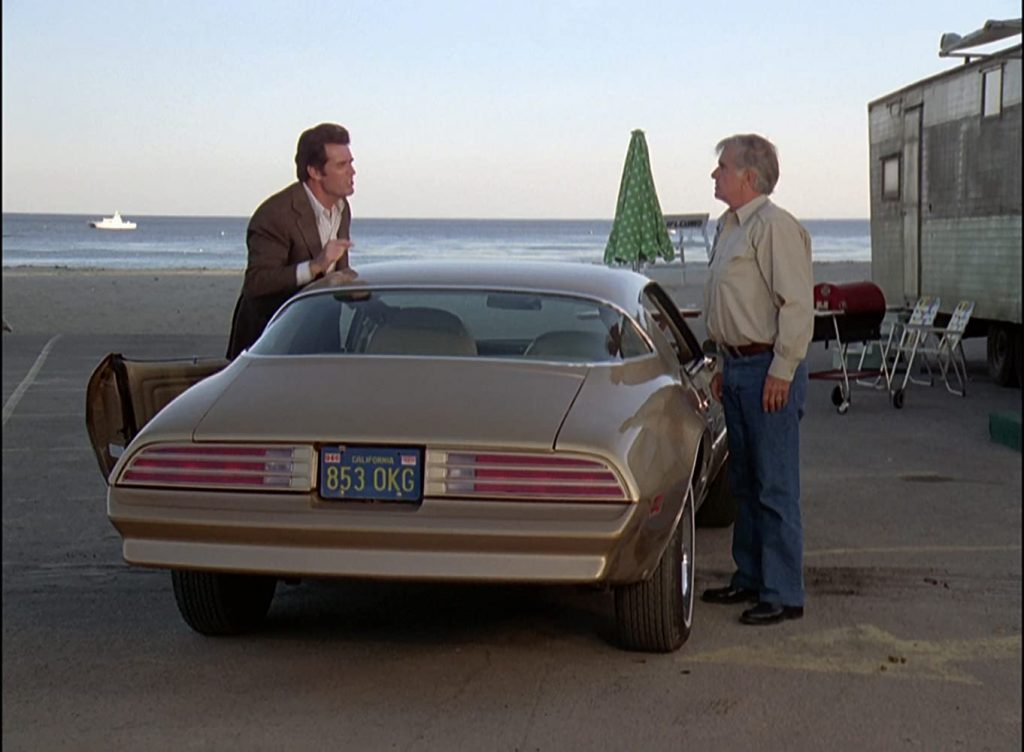
Favorite Episodes

City of 'Affections'
Gabby & Gandy, The Show that Could Have Been
The Rockford Philes
Source: https://crimereads.com/falling-in-love-with-the-rockford-files-all-over-again/
0 Response to "Rocky Movie Chasing Parked Cars Again"
Postar um comentário